




Navigating LGR
Supporting growth through change

Local government reorganisation is reshaping the public sector at pace, creating both significant opportunities and challenges for councils, partners and service providers. As organisations navigate complex structural change, the priority remains the same: delivering reliable, high-quality statutory services for people and communities.
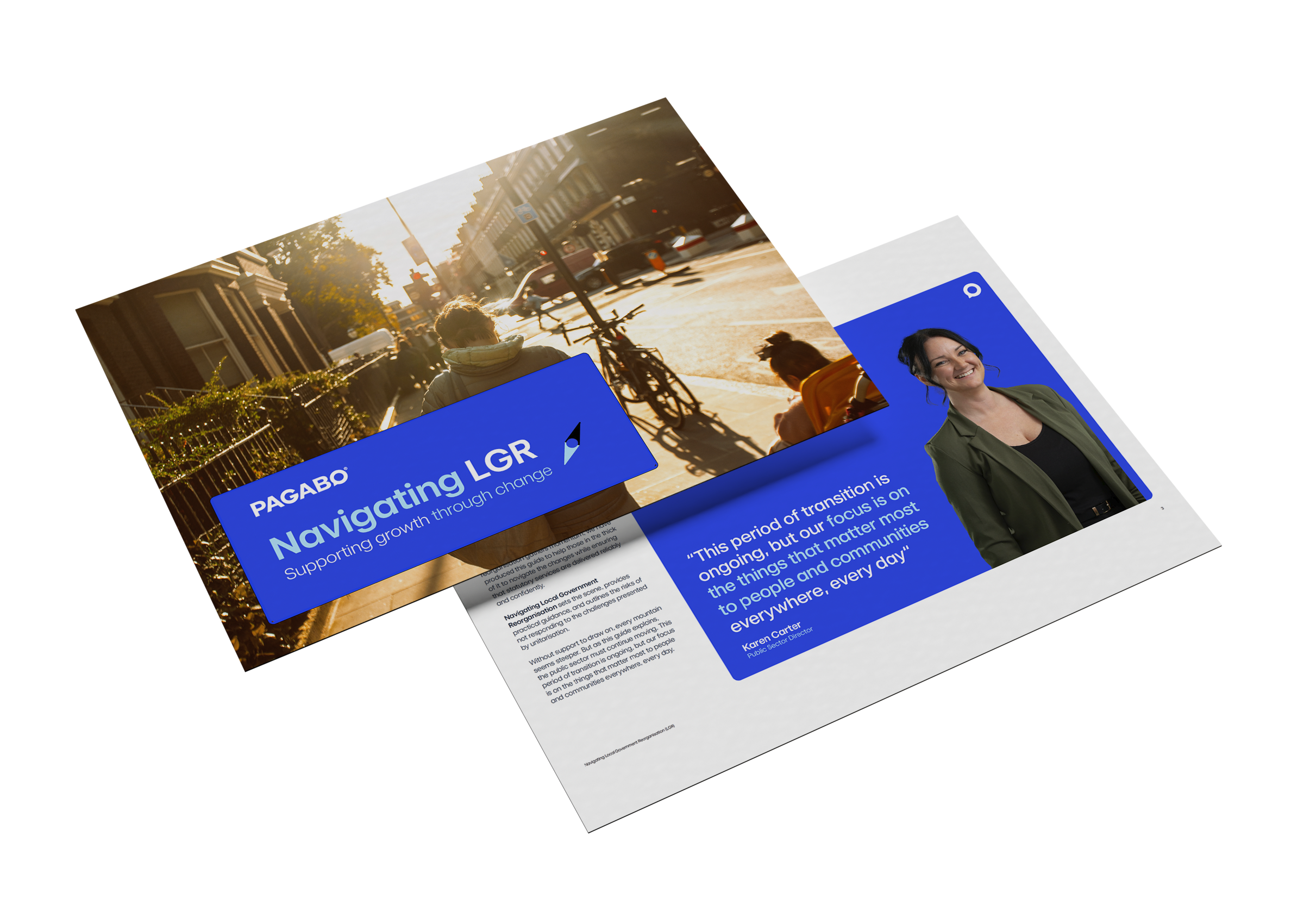
Local Government Reorganisation guide to key updates
Webinar & podcast learning with Pagabo Live

Powering places: System leadership for devolution – challenges, risks, opportunities
UKREiiF podcast with Marie Southgate, Director and SRO, Places for Growth at the Cabinet Office and Meg Carter, Regional Director at AtkinsRealis
Listen now
Pagabo Live webinar with Meg Carter, Regional Director at AtkinsRealis and Gavin Mason, Operations Director at Pick Everard.
Watch now
You can join the Pagabo live community below to be part of a growing public sector audience of over 4,000 people. We host content in a knowledge hub and run monthly CPD accredited webinars around topics such as local government reorganisation, the procurement act, social value, placemaking and more.
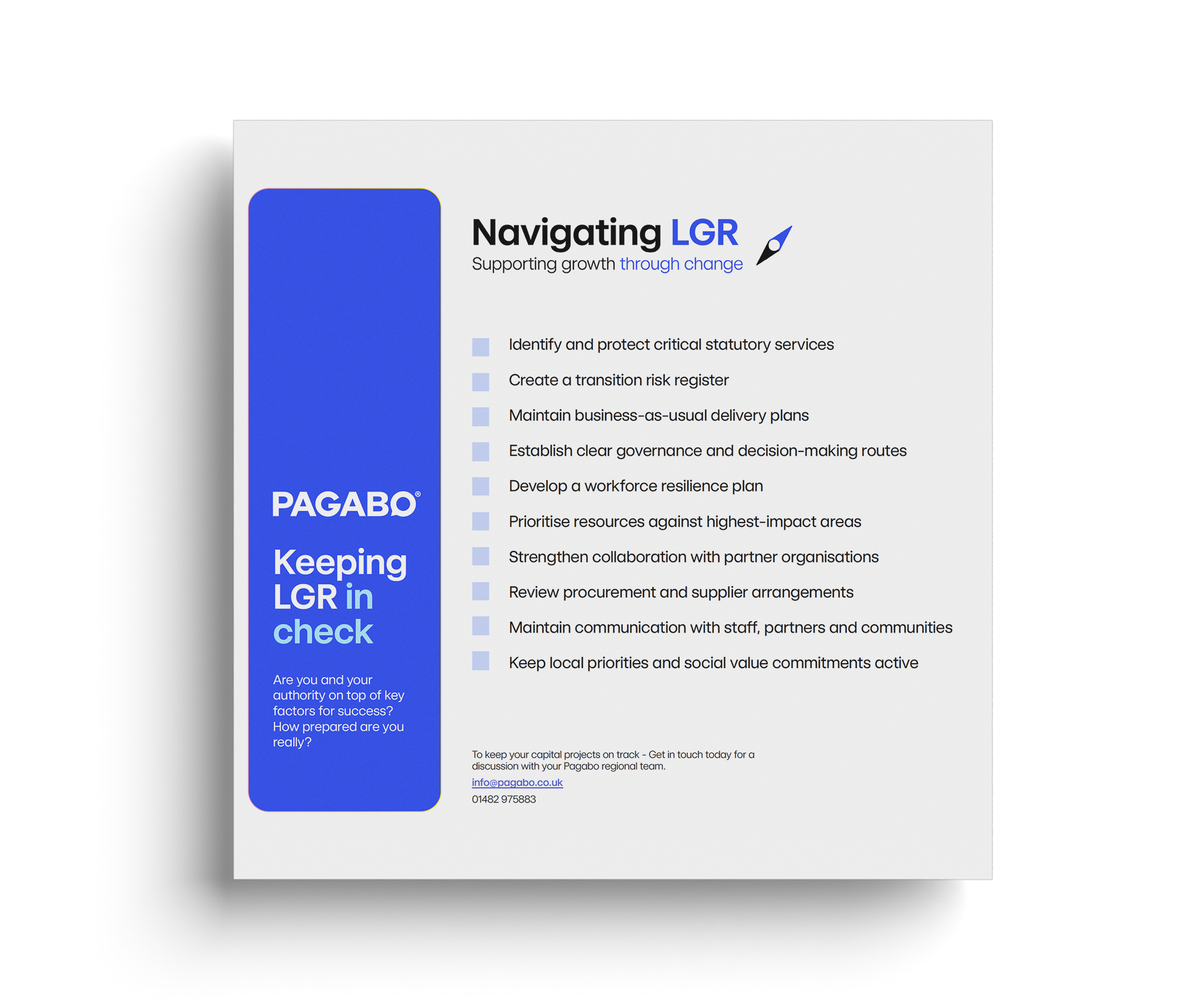
The LGR checklist Are you prepared?

Frequently asked questions about LGR and devolution
Here are some of the most asked questions surrounding LGR and devolution. With local government boundaries and leadership changes taking place it is important to ensure the public sector stay informed, enable business continuity and unlock new growth potential.
-
Where is England with local government reorganisation in 2026?
LGR is nothing new. Where we are today builds on decades of it already happening across England. Previous reorganisations – from the creation of metropolitan counties in the 1970s, through to the establishment of unitary authorities in the 1990s and 2000s, to more recent devolution agreements – have all sought to address a common set of questions.
- How services are best delivered?
- How local areas can collaborate strategically?
- How public funding can be used more effectively?
-
Why is local government reorganisation such a challenge?
For authorities currently navigating transition, the challenge is not simply structural. It’s operational, cultural and deeply practical.
While boundaries are being reconsidered, along with leadership arrangements and governance models, statutory services have to continue. This means delivering large-scale change with no interruption to the delivery of day-to-day services
Communities still expect roads repaired, children safeguarded, bins emptied, parking provision and accessible libraries, for example.
At the same time, authorities are expected to modernise, collaborate more strategically and deliver greater value using increasingly strapped resources.
-
In which areas must authorities undergoing local government organisation maintain statutory obligations?
- Children’s and adults’ social care
- Education
- Library services
- Planning and housing
- Public health
- Road maintenance
- Waste collection
These services form the backbone of local government. They’re the elements that people will notice are impacted first, and with that lies a reputational risk for local authorities if services slip during periods of change.
In many ways, the real success is local people not noticing too much of a day-to-day difference during and after local government reorganisation.
-
Which areas are currently undergoing local government reorganisation? (Local government reorganisation announcement 2026)
Following recent government announcements, a further 14 areas – encompassing 134 existing councils – are set to be streamlined into 38 new unitary authorities. The areas impacted by this latest phase include:
- Derby and Derbyshire
- Devon, Plymouth and Torbay
- East Sussex and Brighton and Hove
- Gloucestershire
- Hertfordshire
- Kent and Medway
- Lancashire, Blackburn with Darwen and Blackpool
- Leicester, Leicestershire and Rutland
- Lincolnshire, North Lincolnshire and North East Lincolnshire
- Nottingham and Nottinghamshire
- Oxfordshire
- Staffordshire and Stoke-on-Trent
- Warwickshire
- Worcestershire
This builds upon an initial wave of accelerated and early-phase reorganisations where structural decisions have already been finalised in:
- Essex
- Hampshire
- Norfolk
- Suffolk
- Surrey
Additionally, final ministerial decisions are currently awaited for Cambridgeshire and Peterborough alongside West Sussex.
This nationwide push follows the blueprint of the previous 2019–2023 reorganisation wave, which successfully transitioned North Yorkshire, Somerset, Cumbria, Northamptonshire, and Buckinghamshire into unitary structures. The sheer scale and rapid geographic spread of these changes mean that a significant proportion of local authorities across England are now simultaneously navigating the operational challenges of structural reform.
-
How will local government reorganisation impact specific jobs?
Using a few examples;
- senior leadership teams will need to balance transformation programmes with immediate – and sometimes urgent – service delivery,
- estates teams will continue to manage complex asset maps, maintenance requirements and capital delivery programmes,
- and procurement teams face increasing workloads, all while organisational priorities are shifting around them.
At the same time, there’s a broader human challenge beneath structural reform. Organisational uncertainty piles pressure on not just how the workforce does what it does, but how those people feel too – morale and retention can be impacted. Collaboration between authorities becomes critical, but so too does clarity of vision, communication and clear leadership from the top down.
-
How can procurement support be provided during local government reorganisation?
A managed framework approach can reduce the time and complexity associated with traditional procurement routes. They can make sure projects continue progressing with all-important compliance and social value expectations to further support local communities and economies – especially with relatively new legislation still bedding in under the Procurement Act 2023. Equally important, it can provide authorities with access to established supply chains and delivery support at a time when internal procurement and legal teams may already be working under extreme pressure and planning for future supplier alignment as part of LGR.
-
What does local government reorganisation feel like at a local level?
Constituents don’t experience local government through organisational charts or governance structures – in fact, they will have almost no awareness or care for that part of the process. For them, it’s their personal experience of outcomes; the quality of housing, accessibility of services, condition of roads and public spaces, and the opportunities they can access within their communities.
That’s why social value has a role to play in successful local government reorganisation. Authorities should be looking beyond generic promises towards outcomes that directly support their local priorities and pressures. In practice, this may mean:
- Creating local employment pathways linked to regeneration programmes
- Supporting skills development aligned to regional economic need
- Improving accessibility and community wellbeing through estates strategies
- Delivering environmental improvements that support local net zero ambitions
- Improving access to social care services
-
How can Pagabo help with local government reorganisation?
Pagabo-managed frameworks enable authorities to procure works, and professional services quickly and compliantly, helping to maintain delivery across key estates priorities such as:
- Ongoing maintenance and lifecycle works to ensure assets remain safe, compliant and operational
- Capital delivery programmes aligned to regeneration, housing and infrastructure priorities
- Estates rationalisation strategies, including repurposing, disposal or optimisation of assets
- Net zero and decarbonisation initiatives across public sector portfolios
- By providing access to vetted suppliers and clear procurement routes, Pagabo helps authorities avoid delays often associated with traditional tendering processes – enabling projects to move forward alongside wider organisational change. This is particularly important during LGR, where time, resource and certainty are all at a premium
- Social value initiatives that empower communities, directly respond to local challenges, and align with estates strategies
Pagabo’s role is not to replace internal teams, but to act as an extension of them, supporting delivery where capacity is constrained and ensuring that estates programmes continue to contribute to wider organisational objectives. In doing so, Pagabo helps authorities maintain operational momentum, protect community outcomes and ensure that estates strategies remain aligned to both current needs and future structures.
In the context of LGR, this means estates procurement becomes a stabilising force rather than a pressure point; enabling authorities to keep moving forward, even as the landscape around them evolves.
